Class & object
Class is Blueprint of object, just like a house blueprint, it does not cost anything but only paper.
Object is the real implementation of that blueprint and cost resources such as memory.
Student Class
  class Student {

    Student() {}

    String id;
    String name;
    String email;
  }
the id, name, email are properties of Student class.
constructor
The constructor is a special method which will be available in all classes.
- if you do not create a constructor then the compiler will add it for you.
- The constructor without any arguments is called
default constructor.
Student Object
In java to instantiate a class we will use new operator and by using it we call the constructor
instantiation is nothing but allocating memory to accomdate the properties and their methods.
Memory for objects are allocated in heap memory (we will talk more about memory in upcoming chapters)
To allocate memory to the object ( Instantiate the object), below is the statement
Student studentObj = new Student(); - studentObj is variable name
- Student is Type of that variable
- we are calling the constructor of the class Student()
- we use the new keyword in front of the constructor method.
- The returned value will be stored in the variable studentObj .
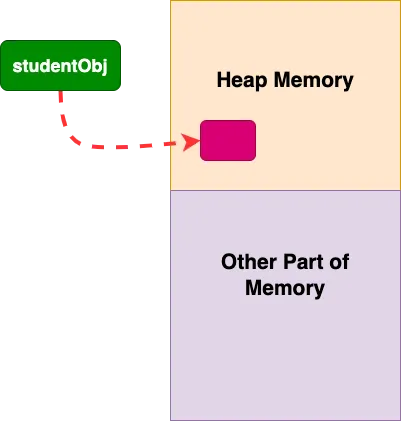
What do you think the vlaue of studentObj variable?
The Student class is instantiated, thus the memory is being allocated for the attributes declared in the class
studentObj is having reference to the object in the heap memory not the object itself.
Lets declare more classes
Student class
  class Student {

    Student(String id, String name, List<Course> courses){
      this.id = id;
      this.name = name;
      this.courses = courses;
    }

    String id;
    String name;
    List<Course> courses;

  }
Course Class
  class Course {

      Course(String id, String name, Professor professor) {
      this.id = id;
      this.name = name;
      this.professor = professor;
    }

    String id;
    String name;
    Professor professor;
  }
Professor Class
  class Professor {

    Professor(String id, String name) {

      this.id = id;
      this.name = name;
    }

    String id;
    String name;

  }
Creatign objects
  class Test {

      public static void main(String[] arg) {
          Professor professor = new Professor("1", "Jhon");

          Course c1 = new Course("1", "DSA", professor);
          Course c2 = new Course("2", "Java Programming", professor);

          List<Course> courses = List.of(c1, c2);

          Student studentObj = new Student("1", "Mathew", courses);

      }
  }
The above code will create the objects as shown in the below diagram.
Shallow Copy
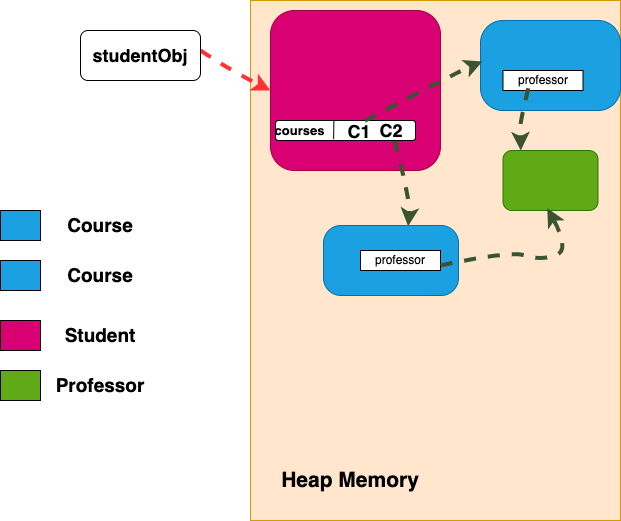
from this diagram, you can see, the object creation ( allocation of memory) happens only during the new keyword usage
everytime when ever the assingment happens through the refernece its always the refernce to the object ( we can call it as remote)
So by having the object reference as value, we will be giving direct access to the object itself, its vital to understand this concept to avoid the basic mistake during the call by value and call by refernce, shallow copy and deep copy issues during object creation and copy.